 ▶56:42
Defining (or Identifying) Recent Trends in Extremism in the UK
Dialogue SocietyDialogue Society organised a panel discussion on "Defining (or Identifying) Recent Trends in Extremism in the UK: Our Communities are under Threat" on 26 February 2020. ► Speakers ● Ian Linden, St. Mary’s University Twickenham (Chair) ● Abu Ahmad, Prevent’s Head of Local Delivery & Communications at the Home Office’s Office for Security and Counter-Terrorism ● Milo Comerford, Senior Policy Manager at the Institute for Strategic Dialogue (ISD) ● Dr Julia Rushchenko, Senior Lecturer in Policing and Criminal Investigations, University of West London ► Abstract Since the 9/11 terror attacks and thDevamını okuDaha az göster
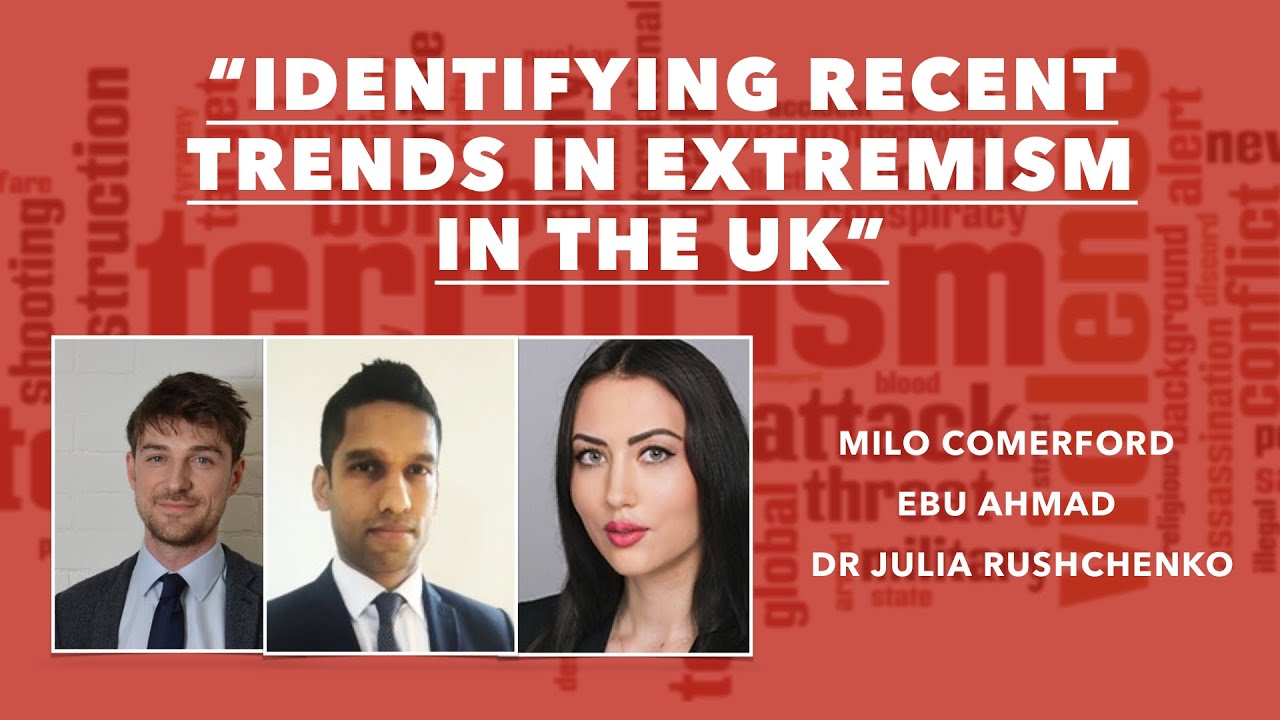
Dialogue Society organised a panel discussion on "Defining (or Identifying) Recent Trends in Extremism in the UK: Our Communities are under Threat" on 26 February 2020.
► Speakers
● Ian Linden, St. Mary’s University Twickenham (Chair)
● Abu Ahmad, Prevent’s Head of Local Delivery & Communications at the Home Office’s Office for Security and Counter-Terrorism
● Milo Comerford, Senior Policy Manager at the Institute for Strategic Dialogue (ISD)
● Dr Julia Rushchenko, Senior Lecturer in Policing and Criminal Investigations, University of West London
► Abstract
Since the 9/11 terror attacks and the London bombings of 7 July 2005, people concerned with extremism have mostly channelled their attention to violent religious extremism. However, this has led to negligence in the understanding of other forms of extremist threats, especially from the far-right. As one senior counter-terrorism officer has recently pointed out, the rise of the far-right is the fastest-growing terrorist threat in the UK. A third of all terror plots to kill in Britain since 2017 were by those driven by extreme-right causes. As the Lead Commissioner for Countering Extremism points out, although jihadists still remain by far the most significant terrorist threat to the UK, along with far-right, other forms of religious extremism, far left, or even animal rights extremism cause considerable concern for the safety of our communities. Therefore, the discussion aims to define (or identify) the recent trends in extremism, whether violent or hateful extremism, and discuss what roles can the government, public bodies, tech companies and civil society play in countering this imminent threat.
► Highlights
Abu Ahmad, Prevent’s Head of Local Delivery & Communications at the Home Office’s Office for Security and Counter-Terrorism
◉ 3:10 Extremism as a global phenomenon, affecting different countries and religions.
◉ 5:40 The shift in those who engage in terrorism.
◉ 6:10 ‘Daesh really changed the landscape of terrorism.’
◉ 6:19 Change in recruitment method; mass radicalisation and the importance of social media.
◉ 7:35 Change in terrorist attack methods; shift to ‘low level-sophistication means’.
◉ 10:00 The need for social media companies to do more to take down dangerous material.
◉ 10:28 What does Prevent do?
◉ 10:42 A rise in the number of right-wing extremism cases.
◉ 11:30 Which individuals are vulnerable to latching onto extremist ideologies?
◉ 12:28 Hard to predict the direction that right-wing terrorism is going.
Milo Comerford, Senior Policy Manager at the Institute for Strategic Dialogue (ISD)
◉ 15:28 ‘Extremism is something that divides communities, that feeds polarisation and conflict and undermines open and pluralistic societies.’
◉ 16:00 Social identity theory of extremism; extremism as an ideological worldview focused on the supremacy of one group over another.
◉ 17:01 Nazi Germany as an example of how extremism can be manifested and mainstreamed in society.
◉ 18:20 A wave of post-organisational extremist violence.
◉ 18:57 Conspiracy theories as a gateway to extremist movement.
◉ 21:13 The hybridisation of ideology; mixed and unclear categories of radicalisation.
◉ 22:38 The need for a data infrastructure to show the shifting nature of extremism on a real-time basis.
◉ 22:35 Localised responses are central.
◉ 24:13 The responsibility of tech companies versus governments.
◉ 25:50 How do we engage civil society more broadly?
Subscribe ►http://bit.ly/SubsDialogueSociety
Donate ► https://www.paypal.me/DialogueSociety
Become a patron ► https://www.patreon.com/DialogueSociety
Visit us ►http://www.dialoguesociety.org
Sign up to our newsletter ►http://eepurl.com/du5E6X
Twitter ►https://twitter.com/DialogueSociety/
Instagram ►https://www.instagram.com/dialoguesociety/
Facebook ►https://www.facebook.com/DialogueSociety
About Dialogue Society
The Dialogue Society is a registered charity (Registered Charity Number: 1117039), established in London in 1999, with the aim of advancing social cohesion by connecting communities, empowering people to engage and contributing to the development of ideas on dialogue and community building. The Dialogue Society is not a religious or ethnic organisation. It aims to facilitate dialogue on a whole range of social issues, regardless of any particular faith or religion. It stands for democracy, human rights, the non-instrumentalisation of religion in politics, equality, and freedom of speech.